Supernovae, Gamma-ray Bursts and Compact Objects
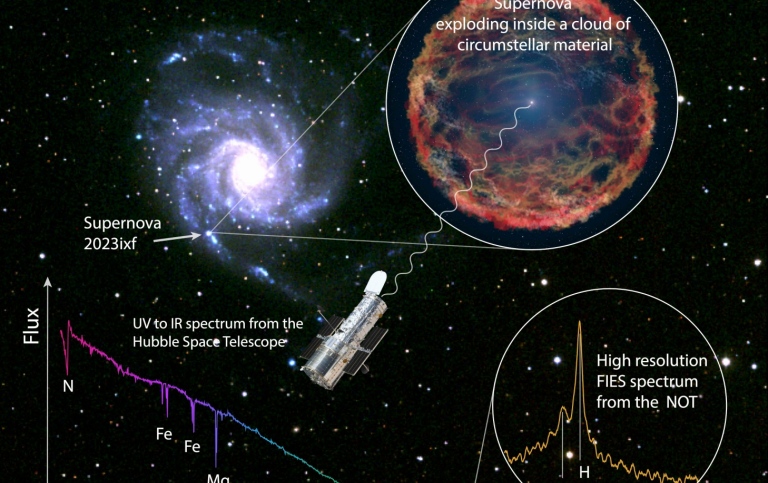
Massive stars end their lifes in gigantic explosions, supernovae. Sometimes these explosions also result in gamma-ray bursts. The end results are newly synthesized elements, neutron stars and black holes.
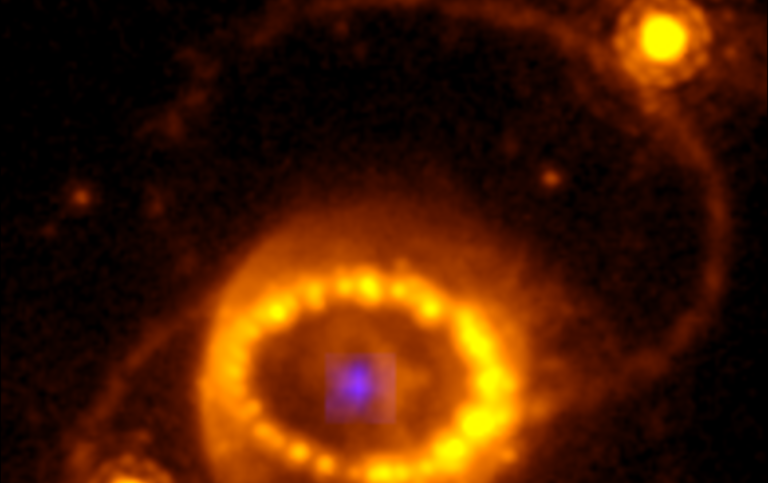
At our department we study both the explosion itself and the radiation resulting from the interaction with the surrounding medium. A well-studied example is SN 1987A. The gamma-ray bursts are even more energetic and can be observed across the Universe.

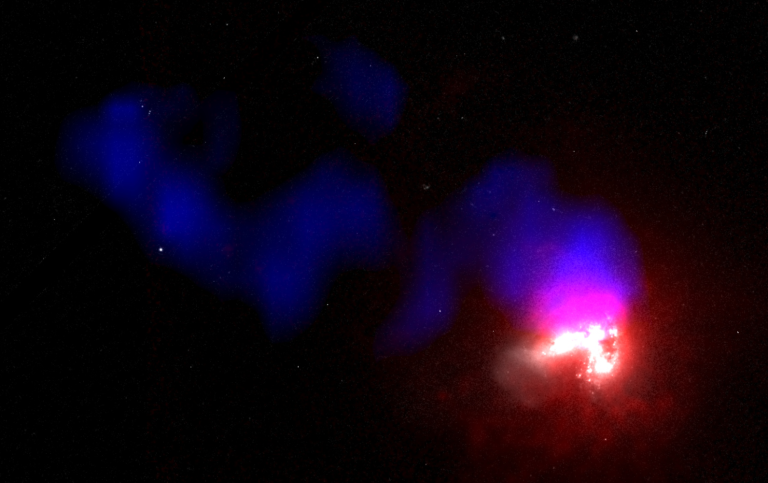
The remnants in the form of a neutron star or a black hole often give rise to radiation in the radio, X-ray and gamma-ray ranges. This is caused by the material accreted onto the compact object. We study these phenomena by ground based telescopes, satellites and balloon instruments.
A related research area at the department is the use of supernovae for cosmology and the study of the cosmic acceleration.
Much of this research is performed in collaboration with the Physics departments at Stockholm University and the Royal Institute of Technology (KTH) in the strong research environment of the Oskar Klein Centre.
Research staff:
Claes-Ingvar Björnsson
Claes Fransson
Cecilia Kozma
Stefan Larsson
Peter Lundqvist
Jesper Sollerman
Göran Östlin
Jens Melinder
Stephan Rosswog
Oleg Korobkin
Ivan Zalamea
Jens Melinder
Research students:
Mattias Ergon
Natalia Lundqvist
Emanuel Gafton
For contact information, please visit our .
Last updated:
September 20, 2012
Page editor:
Bengt Larsson
Source: Department of Astronomy
News
- The Institute for Solar Physics formally moves to SU 2013-04-24
- Light and dust in a nearby starburst galaxy 2013-04-03
- Postdoctoral position at Department of Astronomy, Stockholm University 2013-04-03
- Senior Lecturer in Solar Physics 2013-02-08
- The Institute of Solar Physics moves to Stockholm University 2012-12-17